


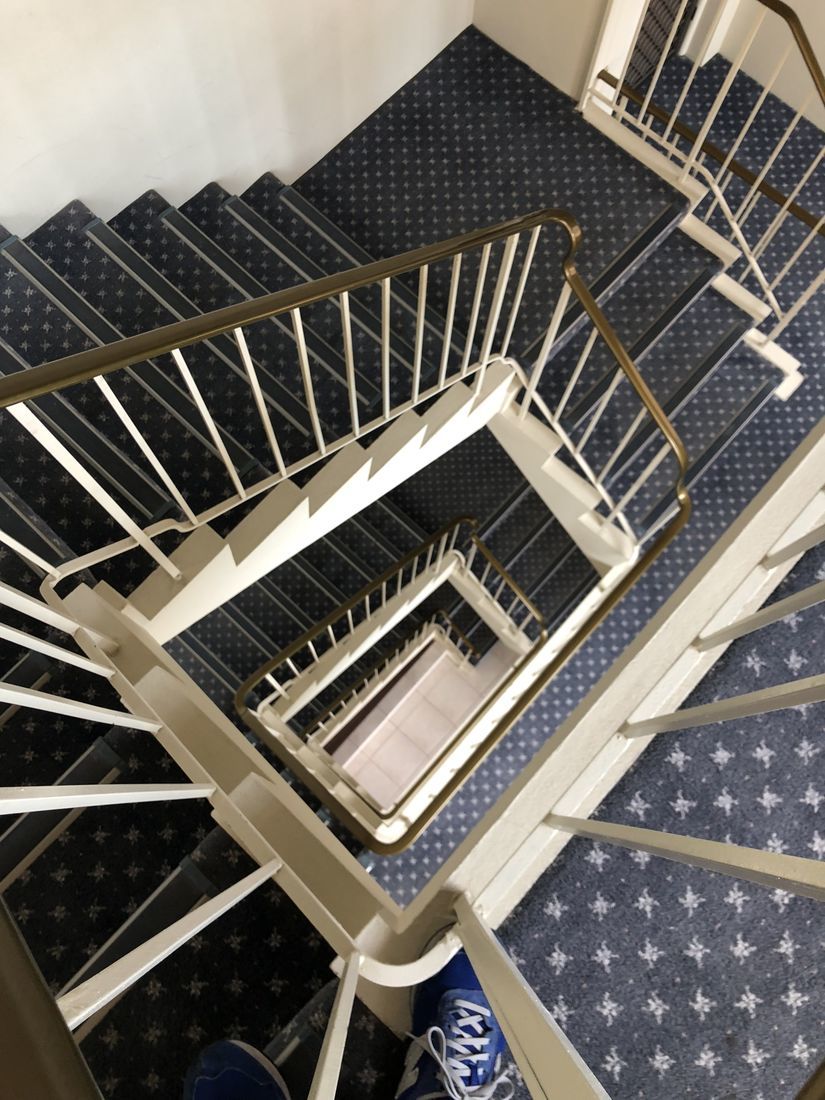
Spiral staircases look beautiful. On moving day, they're one of the hardest things we deal with. A staircase that feels perfectly comfortable to walk up can become a real puzzle when you're carrying a sofa, a chest of drawers or a queen-size bed base.
In Sydney, we see them everywhere: in terraces in the Inner West, in split-level North Shore homes, in loft apartments and in Eastern Suburbs apartments with mezzanine bedrooms. If your home has one, here's what you need to know before you move.
Why spiral stairs are so hard
There's no straight line. On a normal staircase, a piece of furniture travels in a straight line, and the main challenge is the turn at the landing. On a spiral staircase, the whole trip is a turn. Every step, the item has to rotate and tilt at the same time.
The space is tighter than it looks. The useful width of a spiral staircase is the gap between the central pole and the outer rail, and the inner side of each step is very narrow. Long or wide items often can't fit through that curve at all, even when they look like they should.
Low headroom. As the stair turns, the ceiling and the steps above get closer. Tall items like wardrobes, bookcases and fridges hit the underside of the stairs before they reach the next level.
Rails, walls and banisters are everywhere. With a curved rail on one side and a wall or central pole on the other, there's very little room for error. One wrong angle and both the furniture and the staircase can be scratched or dented.
It's harder for the movers too. Carrying a heavy item while turning, climbing and looking around a pole is tiring and risky. The person below takes most of the weight, and the person above often can't see their feet.
How we move furniture on a spiral staircase
1. We plan before moving day. When you tell us there's a spiral staircase, we ask for a photo and the measurements of your largest items. That tells us what will go through, what needs to be dismantled and how many movers we need.
2. We dismantle what we can. Bed frames, tables, desks and many wardrobes come apart. Taking off legs, doors and drawers makes an item lighter, smaller and much easier to turn. We put every screw in a labelled bag and reassemble everything at the other end.
3. We protect every piece of furniture. On a spiral staircase, the edges of your furniture are always close to the rail or the wall. Each item is fully wrapped in thick moving blankets and secured with tape or straps, so nothing slips and corners are covered.
4. We protect the staircase too. Rails, banisters and walls can be padded where the furniture is most likely to touch. A scratched handrail is an expensive repair, and avoiding it is part of the job.
5. We move slowly, as a team. Spiral stairs are not a place to rush. One mover guides from above, one or two take the weight from below, and the team talks every step of the way. Each item takes longer, and that's exactly what keeps your furniture and your staircase safe.
6. We have a plan B. Some items simply won't fit: a large sofa, a solid timber wardrobe, a king-size base. When that happens, we tell you before moving day, not halfway up the stairs. Depending on the home, the alternative can be hoisting the item over a balcony, using another entrance, or deciding together whether the item is worth moving at all.
Does a spiral staircase make the move more expensive?
Most local moves are charged by the hour, so a spiral staircase doesn't add a special fee, but it does add time. Each item has to be wrapped more carefully, carried more slowly and sometimes dismantled and rebuilt. Depending on how much furniture goes up or down the stairs, that can add a noticeable amount of time to your move.
The best way to keep the cost down is to tell us about the staircase when you ask for a quote. That way we bring the right crew and the right equipment, and we can give you an honest estimate from the start.
Tips if you have a spiral staircase
- Tell your removalist when you book, not on the day. Send a photo of the staircase.
- Measure your largest items (length, width and height) and the narrowest point of the stairs.
- Empty drawers and cupboards so furniture is as light as possible.
- Think about what you really need to take. If a large item barely fits, it may be cheaper to sell it and buy new at the other end.
- Clear the stairs of rugs, plants and pictures on the walls before we arrive.
Why it's a job for professionals
A spiral staircase is where amateur moves go wrong: damaged furniture, scratched rails, holes in walls and, worst of all, injuries. Our team has 14 years of experience moving furniture through terraces, apartments and homes across Sydney, the Gold Coast and Brisbane, and we plan every tricky staircase before we lift a single item.
Got a spiral staircase, or any other tricky access? Tell us about it and we'll plan your move around it.
Get a Free Quote or call 1300 108 758.